

Video Borehole Inspection
Stop guessing. We run high-definition 360-degree color camera inspections to pinpoint collapsed PVC, rusted casing perforations, plugged screens, and dropped pump assemblies across Lubbock and the South Plains.
Dual-view lens inspecting side walls and downhole path.
Precision digital footage counter overlaid on live feed.
Identify casing failure before spending thousands on trial.
See Exactly What's Happening Downhole Before You Spend Thousands
Call our dispatch desk to schedule an immediate camera diagnostic before committing to an expensive and potentially unnecessary pump pull or well abandonment.
Schedule Camera Inspection
Enter well depth, location, and symptoms (sand, loss of yield, seized pump) to dispatch a downhole camera rig.
Eliminating Guesswork with Downhole Video Diagnostics
Blindly dropping a brand-new, $2,000 submersible pump down a 40-year-old steel casing is a massive financial gamble. If a domestic well suddenly stops producing water, or begins aggressively pumping heavy sand into your pressure tank, the root cause is hidden hundreds of feet beneath the caliche caprock. Guessing whether the static water level has dropped, the intake screens are biologically fouled, or the casing itself has physically ruptured leads directly to catastrophic equipment failure. If you lower a new pump into a collapsed hole, the motor will either burn up immediately from sand intrusion or become permanently wedged in the pipe, completely destroying the well.
We eliminate this risk by running high-definition borehole video inspection Lubbock services. Before we mobilize heavy drilling rigs for a deepening operation or pull a pump string, we deploy specialized drop camera well diagnostics to visually verify the exact structural condition of your well. Operating across Lubbock, Shallowater, Slaton, Tahoka, and Post, our camera crews capture real-time, 360-degree footage of the subterranean environment, providing physical proof of the mechanical failure before you authorize a single expensive repair.
The Drop Camera Well Diagnostics Workflow
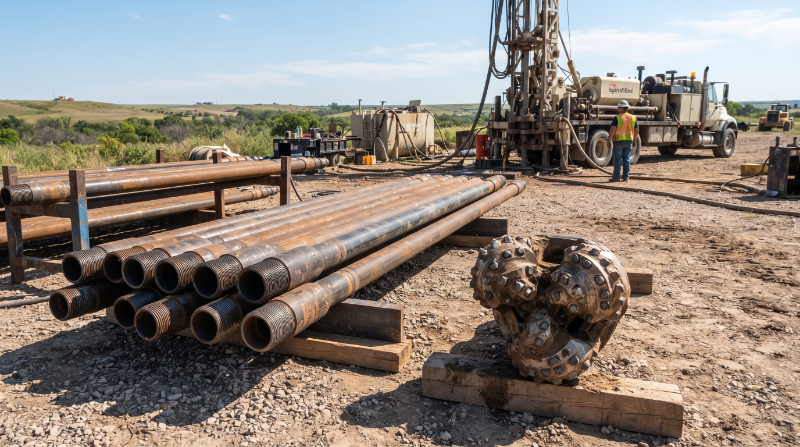
Running a water well camera Lubbock property owners can rely on requires heavy-duty, submersible electronics capable of withstanding extreme hydrostatic pressure. A cheap plumbing inspection camera designed for shallow sewer lines will instantly crush and short out under 200 feet of static water head.
Our crews utilize commercial-grade downhole camera systems mounted on motorized wireline winches.
Total darkness begins just a few feet below the wellhead. Our camera housings are equipped with massive, adjustable LED lighting rings that cut through heavily turbid, sediment-filled water, illuminating the pipe walls with absolute clarity.
Standard cameras only look straight down. Our camera heads feature full 360-degree continuous rotation and a 180-degree mechanical tilt. This allows the rig operator to stop the descent at any depth and physically look sideways directly at the casing joints, PVC welds, and factory screen slots.
As the heavy Kevlar-reinforced wireline unspools into the borehole, an electronic depth encoder measures the exact footage. This measurement is permanently overlaid on the video monitor in real-time. If we spot a massive casing rupture, we know exactly where it is located, down to the inch.
Our operators sit at a surface control station, watching the live high-definition feed as the camera descends. Depending on the specific aquifer profile and the target depth of the Dockum or Ogallala formation, we run these inspections from shallow 100-foot domestic setups all the way down to 500+ foot commercial industrial bores.
Diagnosing Casing Failure and Structural Collapse
The primary objective of a downhole camera well inspection is to execute a definitive well structural integrity test. Well casings in West Texas face immense geological pressure. Over decades, shifting caliche layers, heavy agricultural equipment driving over the surface, and continuous hydraulic vibration take a severe toll on the pipe.
Galvanized Steel Rust Perforation
Many older wells drilled in the 1970s and 1980s utilized thin-wall galvanized steel casing. Over time, constant exposure to highly oxygenated water and corrosive soil conditions causes this steel to oxidize and rust from the outside in. Our camera runs frequently reveal massive holes blown straight through the side of the casing wall. These perforations allow raw, unconsolidated dirt and abrasive gravel to pour directly into the water column, instantly burying the submersible pump. Identifying the exact depth of a rust perforation allows us to determine if the well can be salvaged with a smaller inner PVC liner sleeve, or if the structural integrity is completely compromised, requiring a total abandonment and re-drill.
PVC Casing Collapse and Separated Collars
Modern wells utilize PVC casing, which is immune to rust but susceptible to crushing forces if the original gravel pack was improperly installed. If the native formation shifts, the lateral pressure can literally flatten a thin-wall PVC pipe. A collapsed casing will firmly pinch the drop pipe and submersible wire, making it physically impossible to pull the pump out for service.
Additionally, we use the camera to inspect every single glued collar joint on the PVC string. If the original driller used insufficient PVC cement or failed to chamfer the pipe edges during installation, the joints can pull apart under the suspended weight of the casing string. A separated collar leaves a distinct horizontal gap in the pipe wall, serving as an open doorway for heavy sand bridging and root intrusion. If large mesquite or cottonwood tree roots detect the moisture escaping from a separated collar, they will aggressively grow directly into the casing, completely choking off the borehole.
Inspecting the Ogallala Screen Intervals
The bottom sections of your casing feature horizontal slots designed to let groundwater flow in while keeping the gravel pack out. Across the South Plains, the Ogallala aquifer carries an extremely high mineral load, specifically dissolved calcium and iron.
As the submersible pump creates a localized pressure drop at the intake screen, these dissolved minerals rapidly precipitate out of the water, turning into solid scale. A well casing inspection allows us to visually examine these screen intervals. If your well is suffering from severely reduced GPM yield, the camera will show exactly why: the factory screen slots are entirely plastered over with a thick, rock-hard layer of calcium carbonate scale or thick, slimy biological iron bacteria.
If we confirm the screen is simply blinded off by scale, rather than buried in collapsed dirt, we can save the well. This video evidence dictates our exact rehabilitation strategy. We can mobilize a heavy truck-mounted air compressor to execute aggressive high-pressure air jetting, or we can drop a concentrated chemical acid treatment directly onto the scaled zones to dissolve the mineral blockages. Once the cleanout service is complete, we run the camera down the hole a second time to visually verify that the screen slots are fully reopened and the native aquifer pathways are restored.
Locating Dropped Assemblies and Foreign Objects
A dropped pump is a contractor's worst nightmare. If the galvanized drop pipe heavily rusts at the threaded couplings, the continuous torque of the submersible motor kicking on and off will eventually snap the pipe. When that coupling fails, the entire pump assembly, hundreds of feet of water-filled pipe, and all the heavy gauge copper electrical wire instantly plummet to the bottom of the well.
Extracting a dropped assembly is a high-stakes mechanical fishing operation. You cannot fish blindly. If you blindly drop a heavy steel spear or an overshot tool down the casing, you risk driving the broken pipe horizontally through the PVC wall, permanently destroying the well.
We utilize the downhole camera to guide the fishing process. We lower the camera lens directly over the broken assembly to determine exactly how the pipe is oriented. We need to see if the pipe is standing straight up in the center of the casing, or if the heavy electrical wire has bird-nested over the top of the broken threads, blocking our tool access. By understanding the exact physical geometry of the wreckage, we can custom-fabricate the exact fishing tool required to latch onto the debris and safely winch it back to the surface.
See Exactly What's Happening Downhole Before You Spend Thousands on Guesswork
Contact our Lubbock diagnostic crews to book high-definition camera runs from 100 to 500+ feet.